Citrus greening (HLB) and the Asian citrus psyllid: an operations playbook
How a Florida or California grove team runs Asian citrus psyllid and HLB surveillance week to week: routes, sampling, records, thresholds and block review.
The Asian citrus psyllid (Diaphorina citri) carries the bacterium behind citrus greening, or huanglongbing (HLB), a disease with no known cure that affects all citrus cultivars. An infected tree can't be fixed, but how many psyllids reach and leave your blocks is something the grove team can measure and act on every week. A monitoring program does that job: it puts the same scouts on the same blocks at a fixed frequency, records psyllids and symptoms tree by tree, and turns crossed thresholds into a response before the disease moves to the next block.
This playbook covers the operations side: who walks which blocks, how many trees and flushes to sample, what each observation records, when to act, and how to review results block by block. It works on paper. The thresholds and sampling plans come from UF/IFAS, UC IPM and CDFA. Your agronomist and the state rules still set the final numbers.
How HLB spreads
The pathogen (Candidatus Liberibacter asiaticus, or CLas) is acquired mainly by psyllid nymphs and spread by adults. Females need young flush to mature and lay eggs, and nymphs can only feed and grow on feather flush. So every flush is both a breeding window for the vector and a transmission window for the disease. In UF/IFAS's description, a tree and the next psyllid generation can both become infected within as little as a month.
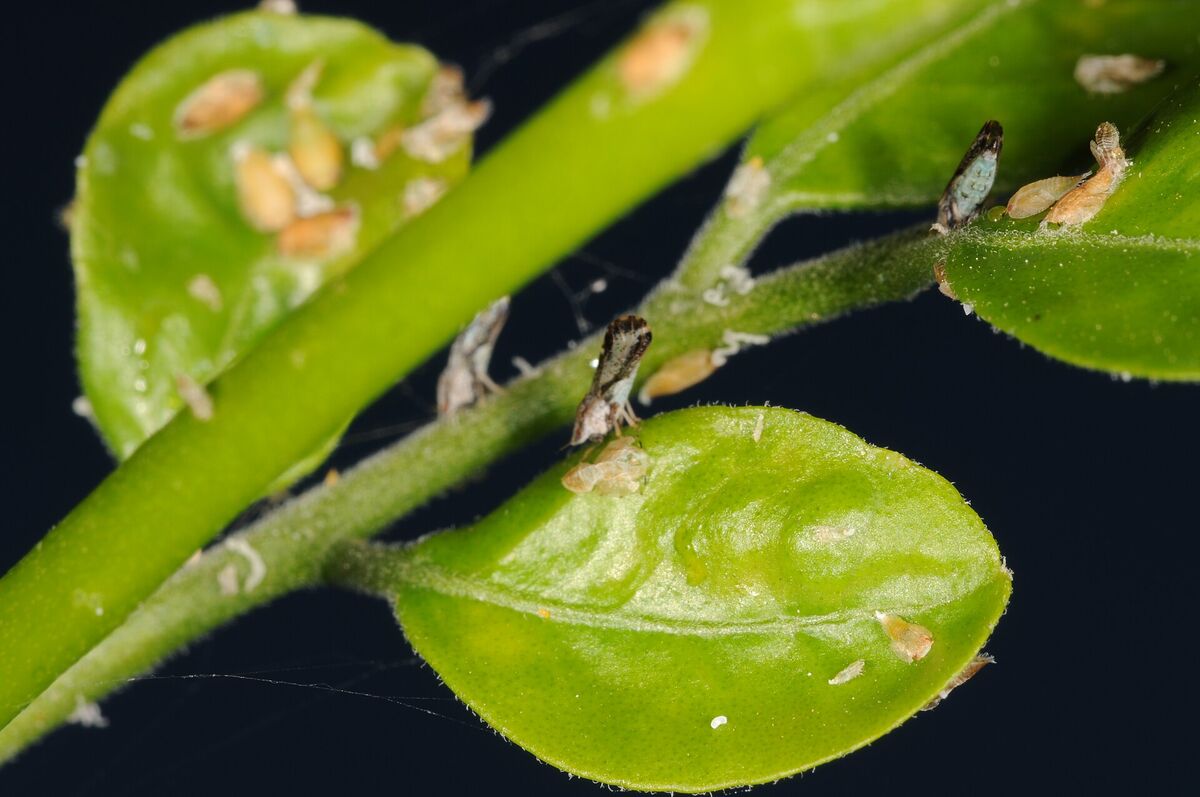
Adults, nymphs and eggs on new flush, where the psyllid breeds. Photo: USDA APHIS, David Bartels, public domain.
Symptoms come much later. UC IPM puts it at upwards of 2 years or more for mature trees, and APHIS warns that an infected tree can remain asymptomatic while serving as a source for other trees. A clean-looking block is not a clean block.
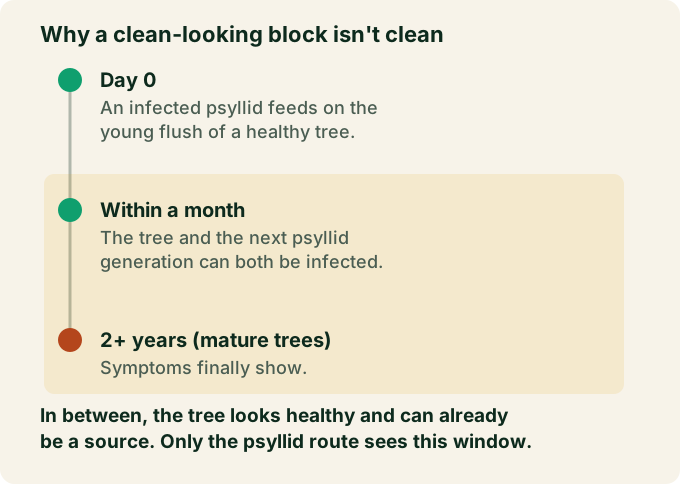
Sources: UF/IFAS for the first month, UC IPM for symptom timing in mature trees, and APHIS on symptomless trees as a source.
Citrus greening in Florida and in California are at opposite stages. In a UF/IFAS grower survey around 2016, Florida operations estimated 90% of their acres and 80% of their trees were infected, and the state's orange crop went from 242 million boxes in 2003-04, before HLB was detected in 2005, to 12.2 million in 2024-25. In California, more than 10,700 trees have tested positive and been removed since 2012, and as of UC IPM's November 2024 update the pathogen had only been documented in residential citrus. Florida growers are managing infected groves. California growers are trying to keep HLB out of commercial blocks.
Psyllids also move. Field trials summarized by UF/IFAS recorded adults traveling 2 kilometers (about 1.2 miles) in 12 days, and they accumulate on the block periphery. HLB also travels in infected budwood and plant material. That is why psyllid control in one grove affects populations in the groves around it.
Symptoms to train scouts on
Scouts need to recognize two things: the vector at every stage, and the disease in the canopy and fruit.
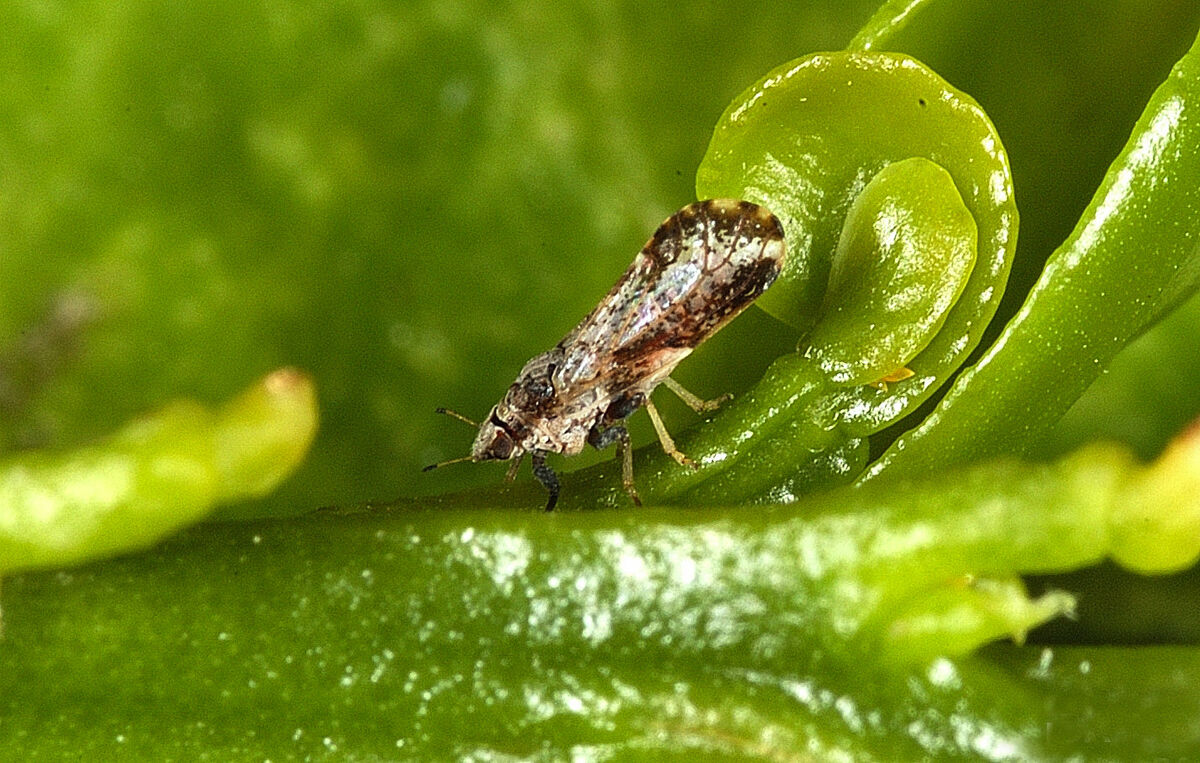
An adult psyllid on young flush. Photo: USDA ARS, David Hall, public domain.
| What to look for | How to recognize it | Commonly confused with |
|---|---|---|
| Psyllid eggs | Tiny, yellow-orange, almond-shaped, in the folds of feather flush | Debris; check with a 10X lens |
| Psyllid nymphs | Older nymphs show wing buds, red eyes and waxy tubules holding honeydew | Other honeydew-producing insects |
| Adult psyllids | Body raised at about 45 degrees while feeding (UF/IFAS gives 30–45 degrees) | No other citrus pest feeds in that posture |
| Blotchy mottle | Yellowing that differs on each side of the midvein; UF/IFAS calls it the most diagnostic symptom | Zinc, iron or manganese deficiency, which yellows both sides evenly |
| Yellow shoot or sector | A single yellow shoot or branch that spreads through the canopy over years | Other causes of a yellow branch; look for mottle on its leaves |
| Fruit symptoms | Small, lopsided fruit, green at the stylar end, with aborted seeds | Uneven ripening; cut the fruit and check the seeds |
| Fruit drop | Heavy drop in the month before harvest | Other causes of preharvest drop |
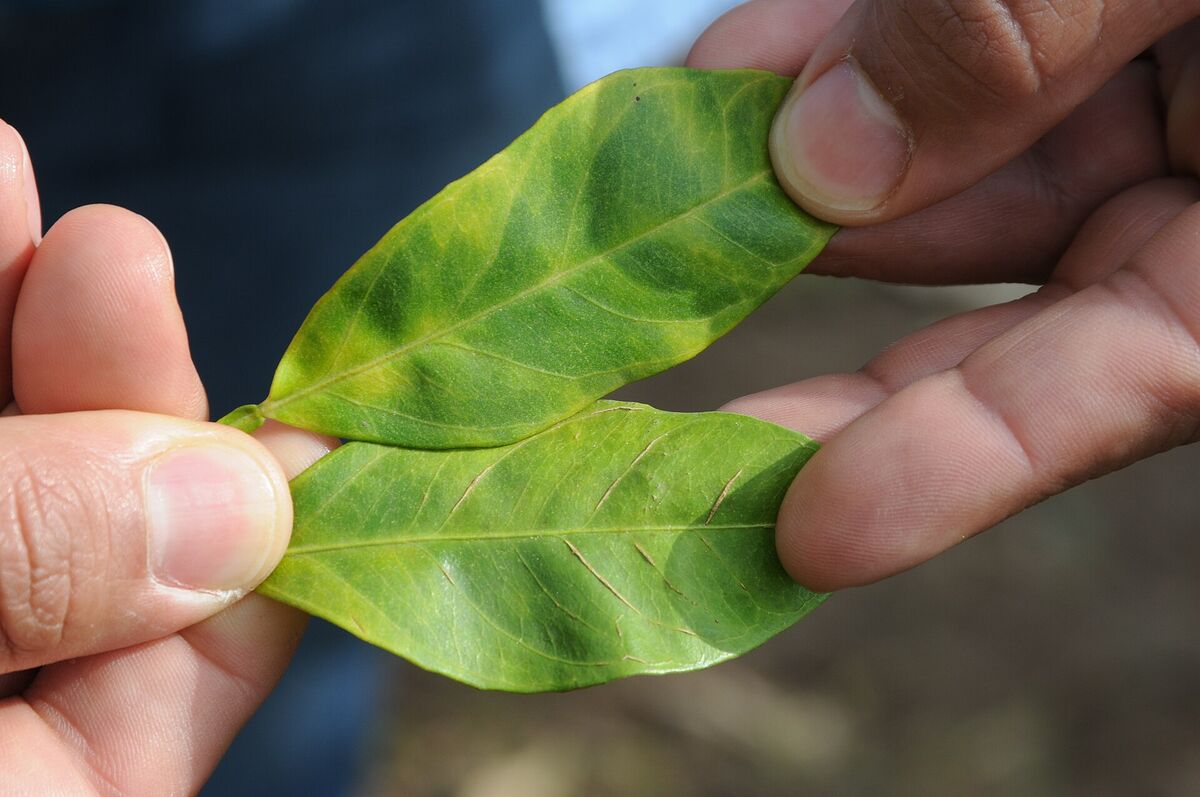
Blotchy mottle: the yellowing doesn't match across the midvein. Texas sweet orange grove. Photo: USDA APHIS, David Bartels, public domain.

An HLB-affected orange cut open: lopsided around its central axis. Photo: USDA APHIS, R. Anson Eaglin, public domain.
Train on the asymmetry first. It is the fastest way to tell an HLB suspect from a nutrition problem, and it is what the lab will need: UF/IFAS notes the bacterium is usually only detectable from blotchy mottle tissue.
Designing a monitoring route
Run two kinds of route, because the vector and the disease move on different clocks.
- The psyllid route samples a fixed set of trees in each block, weighted to the borders, on the newest flush, every two weeks or more often during flush.
- The HLB inspection route walks the block looking for symptomatic trees, a few times a year, and flags every suspect.
To set them up on a 250+ acre operation:
- Split the grove into blocks small enough for one scout to finish in a morning. A block is your unit of decision: one threshold, one spray decision, one row in the review.
- Assign one scout per block, with a backup. The same person walking the same block notices change. Rotate scouts between blocks once a season so no block depends on one pair of eyes.
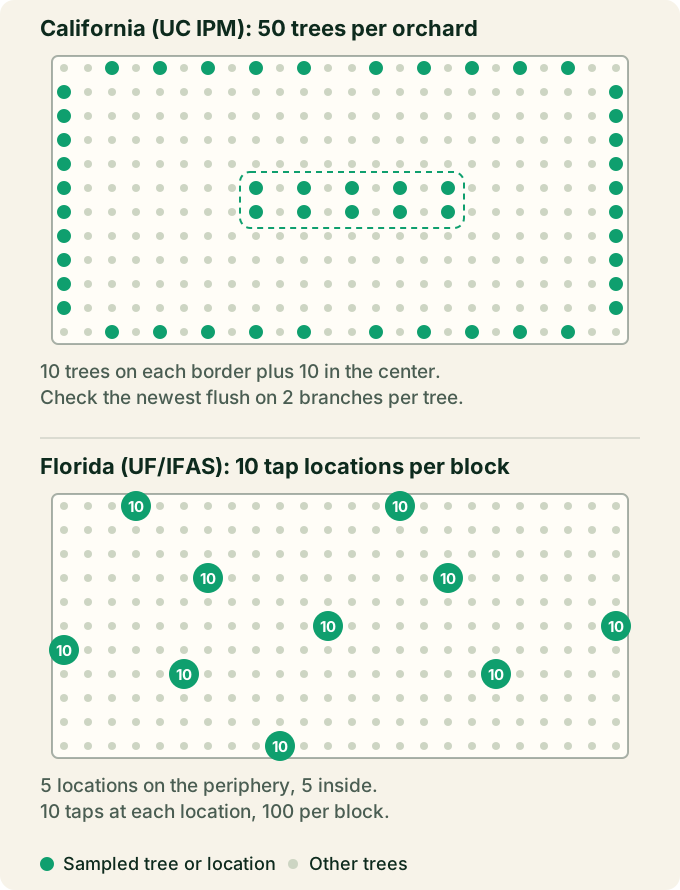
- Fix the sampling points. UC IPM's plan is 10 trees on each of the four borders plus 10 in the center, because standardized sampling is what lets you compare blocks. Number the trees and keep them from route to route.
- Put the borders first. Psyllids first infest border trees, and UC IPM states it is acceptable to concentrate sampling on edges.
- Add the hot spots. Young plantings and resets flush more often and need more frequent monitoring. Blocks next to abandoned or residential citrus get the same treatment.
- Schedule both routes per block and post the calendar, so a missed route is visible the day it's missed, not at month-end.
In Arlo, each block has its own route schedule, and the scout's phone shows the next tree and what to check, even without signal. Pricing is per farm, so every scout gets an account. See sanitation routes.
Sampling: frequency, points per block, flush stage
Florida and California extension programs use different sampling plans. Use your state's plan, write it down, and don't change it mid-season, or the trend breaks.
| UF/IFAS (Florida) | UC IPM (California) | |
|---|---|---|
| Main method | Tap sampling: a branch struck 3 times over a sheet held 1 foot below | Visual check of flush, plus tap sampling and sticky cards |
| Sample size | 10 taps at each of 10 locations per block, 5 on the periphery and 5 inside | 50 trees per orchard: 10 per border, 10 in the center |
| What's examined | Adults falling on the sheet | The newest flush on 2 branches per tree, all stages |
| Frequency | No fixed interval given; sampling during the growing season supports spray decisions | Every 2 weeks through the season, more often in young plantings |


Three rules apply in both states:
- Sample the flush that psyllids use. Eggs and nymphs live only on new growth, and UC IPM asks scouts to record the flush stage (feather, growing or fully expanded) at each sample. Zero psyllids on hardened leaves means little.
- Use sticky cards for detection, not counts. Yellow cards catch adults but are not effective for estimating in-field populations. CDFA uses them for detection at 16 traps per square mile.
- Inspect for symptoms on a separate schedule. UF/IFAS recommends HLB scouting four or more times a year in young plantings where HLB isn't widespread, with symptoms easiest to find from October to March. Florida's early program scouted every tree at least four times a year. In blocks where most trees are already infected, agree with your agronomist what the route is for: finding resets to replace, or tracking decline.
What to record per observation
If a record can't be traced to a tree, a date and a scout, nobody can compare it, act on it or defend it to an inspector. Keep the fields fixed so every route produces the same data.
| Field | Level | Example | Why it matters |
|---|---|---|---|
| Block, date, scout | Route | Block 14, Oct 9, J. Pérez | Coverage and accountability |
| Tree number and GPS point | Tree | Tree 17, ±3 m | Relocate flagged trees; UF/IFAS asks for GPS or a map mark |
| Position | Tree | North border, center | Edge vs interior pressure |
| Flush stage | Sample | Feather / growing / expanded | Tells you whether a zero means anything |
| Psyllid stages present | Sample | Eggs ✓, nymphs ✓, adults ✗ | The flush-infestation threshold |
| Adults per tap | Sample | 1 | The tap-sample threshold |
| HLB symptoms | Tree | Blotchy mottle, yellow sector, lopsided fruit | Suspect list for confirmation |
| Flagged | Tree | Yes, orange tape | Links field marking to the record |
| Photo | Tree | Leaf with mottle | Lets the agronomist review the call |
Arlo saves each sample with its GPS point and accuracy, the time, and a photo when the form asks for one, even offline. See what a route records.
Thresholds and the response plan
Thresholds for the psyllid differ by state and by situation. Where sources disagree, state the one your program uses and why.
- California: UC IPM's treatment threshold is any psyllid stage on 2 or more of 10 flushes, applied whenever any border reaches it. UC IPM also warns that numbers below the threshold still carry transmission risk. If psyllid nymphs or a tree test positive for HLB, treatment and removal become mandatory.
- Florida: UF/IFAS cites one adult per 10 tap samples as economically viable for mature trees with high HLB incidence and fruit going to processing. Its field sheet adds that there is no agreed-upon threshold. That figure was set for that situation. For young trees, fresh fruit or low-incidence areas, ask your agronomist what applies.
- Area-wide timing: Florida's Citrus Health Management Areas and California's Psyllid Management Areas coordinate treatment between neighbors. Your block threshold is one trigger, and the area schedule is another.
Product choice, rate and timing come from the registered label, your state's rules and your agronomist. This playbook doesn't recommend any.
When a scout finds a symptomatic tree, follow the same procedure every time:
- Flag and locate it. Mark the tree with colored tape and record the tree number, row and GPS coordinates.
- Document the symptom. Take a photo of the mottled leaf or the fruit, and note which sector of the canopy shows it.
- Don't move plant material. APHIS asks growers not to move branches or green waste out of quarantined areas.
- Get it confirmed. Symptoms are not a diagnosis; formal diagnosis is by PCR. In Florida, samples can go to the FDACS Division of Plant Industry or the UF/IFAS Plant Diagnostic Center. In California, report suspects to the CDFA hotline at 1-800-491-1899. Inside HLB quarantine zones, regulators collect all samples.
- Remove according to your state. In California, confirmed trees must be removed, and a detection triggers a five-mile quarantine. Florida is under a statewide quarantine, and the UF/IFAS production guide doesn't present removal as mandatory: it says removal generally happens when a tree is no longer productive, or was infected too young to ever produce. The same guide notes that removal is the only way to stop a tree being a source, and that psyllids on it should be controlled first so they don't disperse to resets. Check current requirements with FDACS.
- Close the loop. Record the confirmation result and the removal date, and check the neighboring trees on the next inspection route.
In Arlo, any form field can carry a threshold. When a route crosses it, Arlo emails the people you choose with the value, the threshold and a link to the route. Arlo doesn't diagnose HLB. See how alerts work.
Reviewing results block by block
Review every block each week, looking at the same five things:
- Coverage: Did every scheduled route happen, and did it reach the trees it should have? A block skipped twice during flush is your highest risk, whatever its last count.
- Trend: Compare this route with the last one in the same block. Rising infested flushes on one border usually point to the source: a neighbor, a reset, a residential street.
- Edge vs interior: If only the borders are infested, UC IPM notes that border applications can be enough when the center is clean. Your agronomist decides that.
- Suspects pipeline: Count symptomatic trees flagged, sent for confirmation, confirmed and removed. A flag that sits for weeks keeps feeding psyllids.
- Response check: After a treatment, the next route should show it worked. If nymphs keep appearing on new flush, raise it with the agronomist.
In Arlo, two routes of the same block show side by side, with a heatmap that locates the hot spot tree by tree, and route coverage flags blocks that have gone two weeks without a route. See route comparison.
Common mistakes
- Sampling the middle of the block. That's where psyllids arrive last. Start on the borders.
- Counting on hardened leaves. If there's no flush, record that, and plan the next route for when flush starts.
- Reading sticky cards as a population count. They tell you adults are present, not how many.
- Changing trees or method between routes. Then you can't tell whether the block changed or the sample did.
- Calling every yellow leaf HLB. Symmetric yellowing points to nutrition. Train on asymmetry and send real suspects to the lab.
- Assuming a symptom-free block is clean. Years can pass before symptoms show. The psyllid route is your early signal.
- Flagging trees without a location. A tape on a tree with no number or GPS point is hard to find again in a large block.
- Waiting for the grove-wide spray date when one border has already crossed its threshold.
Running the program in Arlo
The method works on clipboards. Arlo shortens the path from the field to the decision:
- Forms. Build a psyllid form (flush stage, stages per flush, adults per tap) and an HLB inspection form (symptoms, flagged, photo). Set the share of each block's trees a route must cover.
- Schedules. Give each block its psyllid and inspection routes. Scouts walk them on their phone, offline, and finished routes upload when signal returns.
- Alerts. Put your agronomist's threshold on the form field, for example 2 infested flushes in 10. Arlo emails the people you choose when a route crosses it.
- Review. When a route uploads, an AI summary checks each indicator against its threshold and flags what's rising. You can also ask Arlo about a route on WhatsApp, compare routes and check coverage gaps by block.
Diagnosis, reporting and treatment decisions stay with your agronomist and the state.