Pest monitoring and action thresholds: how to set up IPM in an orchard or grove
How to set up integrated pest management on a tree-crop operation: scouting routes, sample sizes, action thresholds, block records and AI-assisted review.
In integrated pest management (IPM), an action threshold is the pest level at which you act. The EPA defines it as a point at which pest populations or environmental conditions indicate that pest control action must be taken, and adds that sighting a single pest does not always mean control is needed. Pest monitoring is how you know where each block stands against that threshold: the same scouts, on the same trees, at a fixed frequency, recording counts that can be compared route to route.
This guide covers the operations side of IPM on a perennial crop such as citrus or avocado: the IPM loop on a tree crop, the difference between the economic injury level and the action threshold, how to design scouting routes, what to record, how to review results block by block, and where AI helps with the analysis. It works on a clipboard. The examples come from UC IPM and UF/IFAS; your PCA or crop consultant and the label set the final numbers.
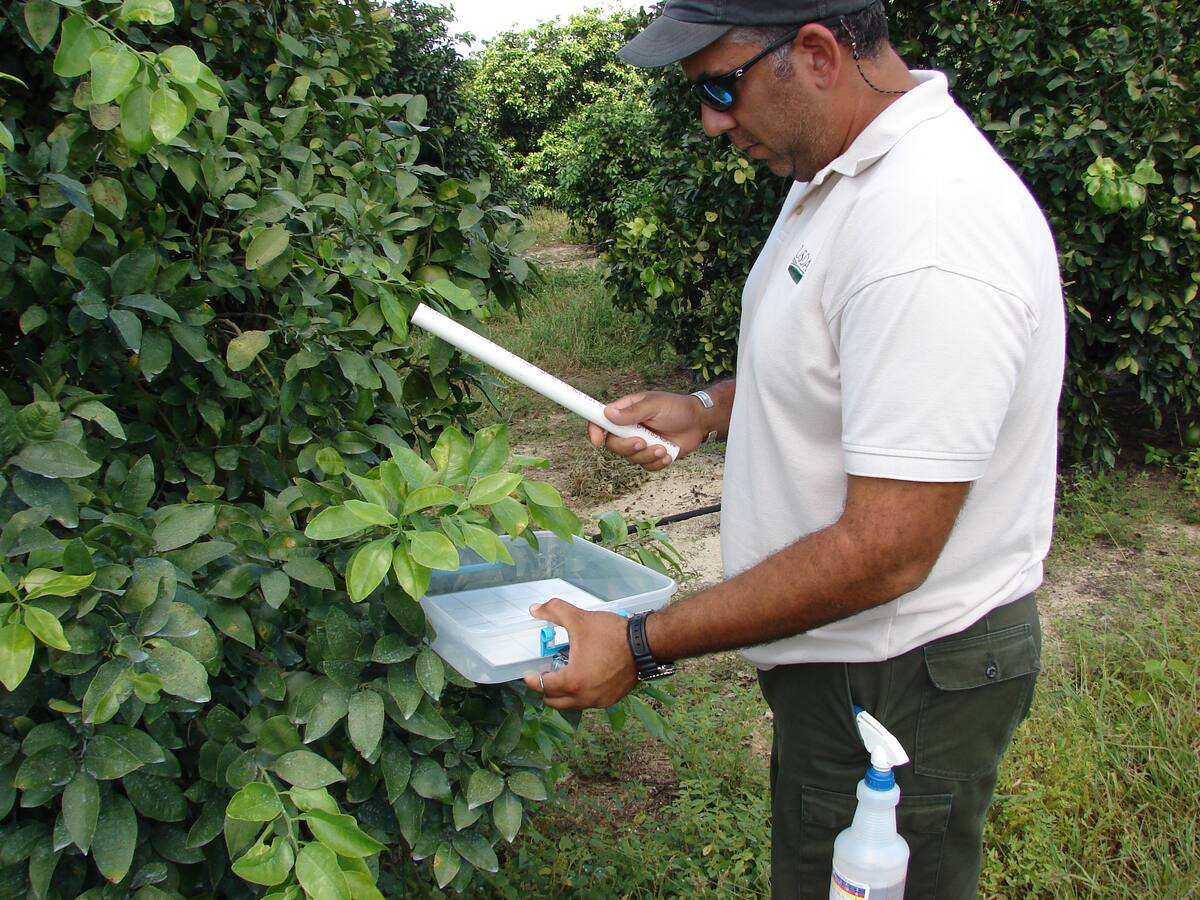
Tap sampling for Asian citrus psyllid in a Florida citrus grove. Photo: USDA APHIS, public domain.

What changes when the crop is a tree
Most IPM material online is written for row crops: the top results for "economic threshold" are almost all field crops. A grove or orchard differs in three ways that change how the work is organized:
- The tree stays. There is no rotation or fallow to break a pest cycle. What happened in a block last season tells you what to expect this season, if someone recorded it.
- The block is the decision unit. Each block has its own variety, age, edges and hot spots. Thresholds, routes and decisions are set per block, not per ranch.
- Phenology sets the risk. Flush, bloom and fruit set concentrate the risk for many pests. The scouting calendar follows the crop stage, not just the month.
UC IPM describes the goal as a strategy where pesticides are used only after monitoring indicates they are needed according to established guidelines. Monitoring and thresholds are the core of the method.
The IPM loop on the ranch
The EPA describes IPM as a four-tiered approach: set action thresholds, monitor and identify pests, prevent, and control. On a tree crop it runs as a loop:
- Prevent. Clean nursery stock, drainage, pruning, weed and edge management. GLOBALG.A.P. asks for evidence of at least two prevention activities that reduce pest incidence.
- Monitor. Fixed routes per block, with a written method: which pest, which plant part, how many trees, how often.
- Compare to the threshold. Each route produces a number per block (thrips per leaf, mites per leaf, psyllids per tap) to compare with that pest's action threshold.
- Decide. If the block crosses its threshold, your adviser decides the response: cultural, biological or chemical.
- Verify. The next route on the same block tells you whether it worked. Without that route, the loop stays open.
- Review the plan once a year. GLOBALG.A.P. requires that the producer evaluates the IPM plan on a yearly basis and introduces improvements. The season's records are what that review runs on.
Economic injury level vs economic threshold (action threshold)
These are two different numbers, and mixing them up is the usual way to act too late. The concept goes back to Stern and colleagues in 1959, who wrote that integrated control is most successful when sound economic thresholds have been established.
| Concept | What it is | Example: avocado thrips (UC IPM, California) |
|---|---|---|
| Economic injury level (EIL) | The lowest population density that will cause economic damage: yield loss equals the cost of management | No published number. Thrips don't affect the flesh, but their scars on the skin cause severe downgrading or culling. The injury level depends on how much scarring your packer accepts and what first-grade fruit is worth |
| Economic threshold (ET), or action threshold | The pest density at which management action should be taken to prevent an increasing pest population from reaching the economic injury level | An average of three to five thrips per leaf at fruit set |
The threshold sits below the injury level because any action takes time to work while the population keeps growing. Pedigo notes that some workers refer to the ET as the action threshold for exactly that reason: it is a time to act. The EIL itself is a calculation, C/VIDK: the cost of management divided by the crop's market value, the injury per pest, the damage per unit of injury and the share of the attack the control prevents.
The thrips example shows something else: a threshold is rarely just a number. UC IPM ties it to a crop stage, because almost all damage occurs when fruit are 0.2 to 0.6 inches (5–15 mm) long, and to the grower's situation: treatment decisions also depend on grower tolerance for scarring, whether a treatment is feasible, and the risk of disrupting natural enemies. If the threshold depends on fruit size, the scout's form needs fruit size next to the count.
Citrus red mite shows the same thing from the other side. In San Joaquin Valley navels, UC IPM says economic loss will not occur if densities do not exceed eight mature females per leaf by 2 to 4 weeks after petal fall, and adds that vigorous, well-irrigated trees can tolerate more. The injury level belongs to the block, not just to the pest.
Citrus rust mite (Phyllocoptruta oleivora) shows both numbers side by side. In Brazil, Embrapa's control level is on average 10% of fruits or leaves with 20 or more mites per cm², while Fundecitrus puts the economic injury level on orange fruit at 70 to 80 mites per cm². The scout acts when one fruit in ten reaches 20 mites per cm², long before the density that causes loss: Embrapa notes that attacked fruit is downgraded commercially and, depending on the infestation, loses weight and juice quality.
For Asian citrus psyllid in Florida, UF/IFAS reports that one adult per 10 tap samples during the growing season gave economically viable suppression in mature trees with high HLB incidence and fruit destined for processing. The same extension service also says there is no agreed-upon threshold for control of ACP. For the full psyllid program, see the citrus greening operations playbook.
Where no published number fits, build your own from records. UC IPM's advice is to establish thresholds by regularly monitoring plants in a consistent and systematic manner, keep good records and compare them with the crop you sold and the price you got. GLOBALG.A.P. expects the same: an IPM plan with action thresholds defined by the producer.
The IPM plan: one row per pest
In practice the written plan fits in a table with one row per pest. An example, which your adviser adjusts to your ranch:
| Pest | Blocks | Sample | Frequency | Threshold and source | Response |
|---|---|---|---|---|---|
| Avocado thrips | Blocks at bloom and fruit set | 10 young leaves on 10 trees | Every 7 to 10 days until fruit pass 0.75 inch | 3 thrips per leaf at fruit set (UC IPM guideline, adjusted by your adviser) | Adviser decides; follow-up route a week later |
| Citrus red mite | All navel blocks | 100 fully expanded leaves per orchard | About every 2 weeks from March | 8 mature females per leaf by 2 to 4 weeks after petal fall (UC IPM, San Joaquin Valley) | Adviser decides; follow-up route two weeks later |
| Asian citrus psyllid | All blocks, edges first | 10 taps at 10 locations per block | Every 2 weeks, more often in young plantings and resets | Set by your adviser and area-wide program | Adviser decides; coordinate with neighbors |
Every cell should answer an auditor's question: who, where, how often, and why that number.
How to design pest monitoring routes
In practice a ranch runs three kinds of route, each designed differently:
| Route type | What the scout does | Example |
|---|---|---|
| Intensity sample | Checks a fixed number of trees or plant parts and counts | Citrus red mite: 100 fully expanded leaves from throughout the orchard, from just inside the shady part of the tree |
| Symptom search | Walks the block and records only affected trees | HLB inspection, Phytophthora, laurel wilt |
| Traps and hot spots | Visits fixed points, or logs each hot spot found | Yellow sticky cards, ant mounds |
To set the routes up:
- Build routes a scout can finish in a shift. If a block doesn't fit in one, split the route. Each block is a row in the weekly review.
- Write the protocol for each pest. Which plant part (flush, leaf, fruit, branch), how many per tree, how many trees, which walking pattern.
- Convert the protocol's sample for each block. Protocols ask for trees or leaves per block or per grove, and some for a share of the trees. UC IPM checks avocado thrips on 10 young leaves on at least 10 trees per grove; UF/IFAS recommends 10 tap samples in each of 10 locations per block, 5 on the periphery and 5 in the interior. If your tool samples a percentage of each block, check how many trees that gives in a small block and a big one.
- Set the frequency by pest and season. UC IPM scouts avocado thrips every 7 to 10 days beginning as early as April and citrus red mite about every 2 weeks from March in the San Joaquin Valley (from late summer in Southern California).
- Include the edges. Many pests enter from the side facing a neighbor, a road or a windbreak. UF/IFAS notes that ACP tends to accumulate on the block periphery.
- Assign one scout per block, with a backup, and publish the calendar so a missed route shows up the same day.
- Train scouts to count the same way. Go through photos of each pest and life stage with them, and now and then send two scouts to the same trees and compare their counts. A Fundecitrus researcher found, sampling citrus mites in Brazil, that different inspectors sampling the same block on the same day reach different estimates. If they count differently, the block's trend means nothing.
How many trees is enough to catch a problem? Basic probability gives a sense of scale: for a 95% chance of finding at least one affected tree when 5% of the block is affected, you need about 60 randomly chosen trees; at 1%, about 300. That assumes the scout never misses an affected tree, and a zigzag route through a clustered pest lowers the odds. A small sample estimates a common pest well but can miss a hot spot that is just starting.
What to record on each observation
An observation that can't be tied to a block, a date, a tree and a scout can't be compared or shown to an auditor. UC IPM's monitoring forms for citrus and avocado start from the same core: block, date and a count per sample. A complete record carries:
| Field | Example | Why it matters |
|---|---|---|
| Block, date, start and end time, scout | Block 7, Oct 9, 7:10–8:05, J. Smith | Coverage and accountability |
| Tree or site, with location | Site 12, GPS point | Getting back to the hot spot |
| Crop stage | Fruit set, 10 mm fruit | Knowing whether the risk is high |
| Pest and sample unit | Avocado thrips, young leaves | Everyone counts the same thing |
| Units checked | 10 leaves | The denominator |
| Count or presence | 38 thrips | The value per tree |
| Extra threshold condition | Fruit size | Whether fruit is still in the damage window |
| Natural enemies, where the protocol uses them | Predatory mites per leaf | Not treating where biocontrol is winning |
| Photo | Scarred fruit | Your adviser can check the call |
UC IPM's citrus checklist sums it up: record results on a monitoring form. Applications go in a separate record that names the target pest. For restricted-use pesticides, federal rules require the brand name and EPA registration number, amount, location, crop, date and applicator, kept for two years. Tie each application back to the route that triggered it. GLOBALG.A.P. requires records to be kept for a minimum period of two years.
Arlo saves each sample with its GPS point, the time, and a photo when the form asks for one, even offline, and the form carries whatever fields your protocol needs. See sanitation routes.
Reviewing results block by block
Review every block every week and look at the same five things:
- Coverage: did the scheduled routes happen, and did they reach the trees they should? A block with no route during bloom is your biggest risk, whatever its last number.
- Threshold: which blocks crossed it, and which are close?
- Trend: compare the route with the block's previous ones. 1.5% coming from 0.5% can be more worrying than a steady 1.5%.
- Hot spot: is the problem across the block or on one edge? A hot spot allows a spot treatment, if your adviser decides on one.
- Response: after an action, the next route should show the effect. If it doesn't, take it to your adviser.
Where AI helps with the analysis
A 500-acre ranch running five scouting protocols produces hundreds of routes a season. Reading them all, comparing each with the last ones and checking them against the weather is the work that falls behind first. AI helps there, with one condition: it can only analyze what was recorded. A ranch that scouts on paper or by text message gives AI nothing to read. Routes with a block, a tree, a GPS point and fixed fields do.
What Arlo does with AI today:
1. A summary of every route, when it uploads. When a scout finishes a route, Arlo writes a short summary. It compares each indicator with the block's recent routes and says whether it is rising, falling or new; checks it against the alert thresholds you set and flags values close to them; cross-references other forms on the same block and the past week's weather; proposes actions by priority; and rates its confidence in the data. Here is a real excerpt, translated from Spanish: the mite route on block 20 of Navelinas SAS, a citrus estate in Colombia, on October 8, 2026.
Summary. "The priority is citrus rust mite: it reached 8.17%, crossed the configured threshold of 8%, and rose sharply from 1.07% on September 29 and 7.50% on August 27. The average number of mites per lens field is still low (0.26), but the detection comes during fruit set, with most fruit in advanced grades, so there is a risk of cosmetic damage and loss of quality if the population keeps growing."
Citrus red mite. "Citrus red mite is present but still below the 5% threshold; however, its increase from 1.61% on September 29 to 3.85% puts it in the preventive warning range."
Moderate confidence. "The current route has 208 samples, but it inspected 13 trees against 35 on previous routes; the current percentages are therefore useful to trigger the alert, but the comparison of population size is less precise."
Notice three things. The 8% is the threshold the estate configured, measured as the share of samples with rust mite; every operation sets its own. The summary flags red mite before it crosses its threshold. And the confidence note asks what a good adviser would ask first: was the sample big enough?
The same summary also proposed a treatment, with products and rates it found online, which we don't reproduce here. For high or critical findings, the summary searches the web for products and rates published for your crop and country, and Arlo's assistant gives them too if you ask. They are not Arlo's recommendation: your adviser checks them against the registered label before anything is applied. To see which trees the pest is concentrated on, the route's heatmap places each one.
2. Ask your ranch, in Arlo or on WhatsApp. Arlo's AI answers from your own records. Some questions you can ask:
- "Which blocks crossed the thrips threshold this month?"
- "How does mite pressure in block 4 compare with last month?"
- "Which sanitation routes are overdue, and whose are they?"
3. Analyze your ranch with Claude, ChatGPT or Grok. If your team already uses one of them, you can connect it to Arlo and do the analysis there: sign in with your Arlo account and authorize the connection.
4. Draft forms and alerts. An AI wizard drafts the monitoring form from the crop and the pests you want to follow, including the sampling mode and fields, and another proposes alerts with their thresholds. Treat both as drafts: your adviser approves the protocol and the final threshold.
AI doesn't diagnose a disease or replace your adviser. It tells you faster what changed, where, and how much to trust it, so the conversation with your adviser starts with the right block.
Common mistakes
- Waiting for the economic injury level. By the time damage equals the cost of control, you're late.
- Changing the method mid-season. If the trees, the plant part or the scout change without a note, you can't tell whether the block changed or the sample did.
- Using the same percentage on blocks of very different sizes without checking how many trees it gives. Big blocks get oversampled and small ones undersampled.
- Looking at the ranch average. The average hides the block that crossed its threshold.
- Recording without a denominator. "38 thrips" means nothing without the number of leaves checked.
- Treating without checking afterwards. Without the follow-up route, nobody knows whether it worked.
- Borrowing another region's threshold without saying so. A number from another state or country is a starting point; write down where it came from.
Running IPM in Arlo
The method works on a clipboard. Arlo shortens the path from the route to the decision:
- Forms and routes per block, with your protocol's fields and the share of each block that gives the trees it asks for, walked on the phone offline with a GPS point for each tree.
- Alerts with your adviser's threshold on each field. When a route crosses it, Arlo emails the people you choose.
- Review with the AI summary of each route, route-to-route comparisons, heatmaps and questions to Arlo's AI in the app, on WhatsApp or from Claude, ChatGPT or Grok.
Diagnosis, product choice and rates stay with your PCA or crop consultant and the registered label.