Avocado pests and diseases: a scouting guide by crop stage
Avocado pests and diseases by crop stage: what to scout, how many trees, how often, what export programs ask you to record, and where AI helps with review.
Avocado pest and disease scouting follows the crop stage, not the calendar month. Thrips are checked from bloom through fruit set, persea mite through the warm months, fruit borers whenever there is fruit on the tree, and Phytophthora root rot after wet spells. Anthracnose infects in the grove but doesn't show until the fruit ripens after harvest. In Latin American export orchards, fruit and seed borers are quarantine pests, and the plant health authority sets how many trees to check, how often and what to record.
This guide organizes that work for a Hass avocado grove: what to check at each stage, how to sample each pest and disease, what to record, and where AI can help review the routes. It doesn't recommend products or rates: that's your pest control adviser's call, with the registered label. The general method is in our guide to pest monitoring and action thresholds.
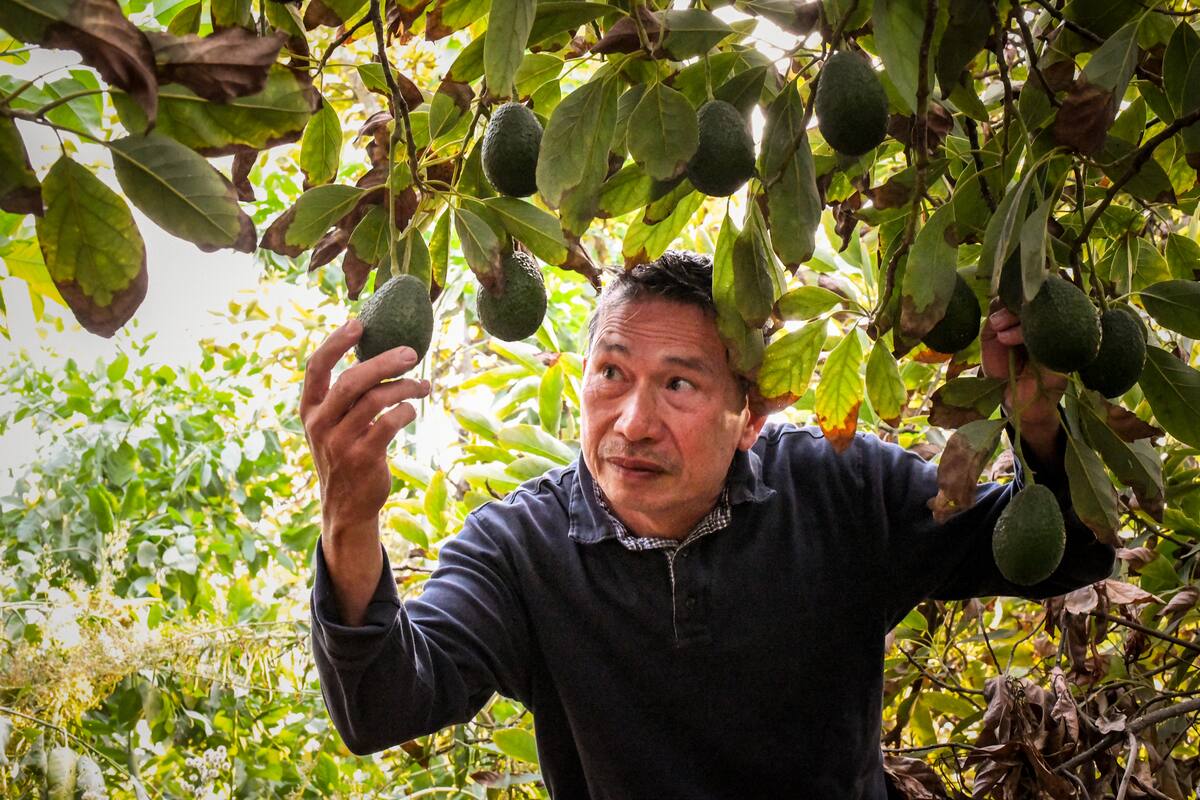
A grower checks the fruit in his avocado grove in Fallbrook, California. Photo: USDA, public domain.

Avocado pests and diseases at a glance
| Problem | What it damages | When to look | How to check |
|---|---|---|---|
| Avocado thrips (Scirtothrips perseae) | Scars on the fruit skin | Bloom to fruit set | Young leaves with a hand lens; count thrips per leaf |
| Persea mite and other mites | Leaf spotting, bronzing, leaf drop | Spring through summer (persea mite peaks July–August) | Underside (persea mite) or upper side (red mites) of leaves, with a lens |
| Avocado lace bug | Leaf discoloration | Summer | Leaf undersides |
| Fruit and seed borers (Heilipus lauri, Stenoma catenifer; Conotrachelus in Mexico) | Fruit, seed and, for Stenoma, branches | Whenever there is fruit | Canopy plus 10 fruits per sample tree, per the export program |
| Monalonion velezangeli (Colombia) | Shoots, flowers and fruit | From the start of bloom | Fresh damage in the middle and upper canopy |
| Anthracnose | Fruit after harvest | Infects from fruit set to harvest; shows when fruit ripens | Risk conditions in the grove, culls at the packinghouse |
| Avocado scab | Young fruit and leaves | Young tissue in wet weather | Fruit with lesions out of fruit checked |
| Phytophthora root rot | Roots; the tree declines | After heavy rain, in poorly drained soil | Walk the block for symptomatic canopies; check roots of suspects |
| Sunblotch and cankers | Fruit, twigs and bark | Any route | Suspect tree, photo and lab test |
| Laurel wilt (Florida) | Kills the tree | Year-round | Green-leaf wilting in part of the canopy |
The sections below give the method for each, with its source. Your adviser sets the final numbers.
Scout by crop stage, not by month
An avocado block goes through flush, bloom, fruit set, fruit growth and harvest, and each pest has its window inside that cycle. In California, UC IPM's calendar follows that cycle: check the new flush in February and March, then thrips and mites every 7 to 10 days from as early as April.
In the tropical highlands of Colombia and Mexico, which ship Hass to the US, there's more than one bloom a year, so a single block can be in flower and carrying fruit close to harvest at the same time:
- Colombia. In Antioquia, Agrosavia describes two blooms: the first in August and September, which gives the off-season crop, and the second between January and March, which gives the main crop.
- Mexico. In Michoacán, INIFAP and the Universidad Michoacana recorded up to four blooms (loca, aventajada, normal and marceña), from August to March, with the normal bloom the largest.
So it's worth recording the stage on every route, tree by tree, instead of assuming it from the date:
| Stage | What to check | Why |
|---|---|---|
| Flush | Mites, Stenoma in branches | Mites go for new tissue |
| Bloom | Thrips, Monalonion, anthracnose and scab risk | Flowers and newly set fruit are the most vulnerable |
| Fruit set and small fruit | Thrips, borers, scab | Scars and fungal entry points happen now |
| Fruit growth | Borers, persea mite in summer | Borer damage shows more as the fruit grows |
| Pre-harvest and harvest | Borers, dropped fruit, packout quality | The export window, and the stage that reveals anthracnose |
| Year-round | Root rot, sunblotch, cankers, laurel wilt | Tree diseases, not stage diseases |
Avocado thrips: bloom to fruit set
Avocado thrips feed on young leaves and small fruit and leave scars on the skin that cost grade at the packinghouse. UC IPM's method:
- Sample: look for thrips on 10 young leaves on at least 10 trees per grove, using a hand lens on the underside of tender leaves.
- Frequency: every 7 to 10 days, starting before young fruit are present and continuing until most fruit exceed 0.75 inch in diameter.
- Damage window: almost all damage happens when fruit are 0.2 to 0.6 inch (5 to 15 mm) long.
- Guideline: an average of three to five thrips per leaf at fruit set warrants treatment, weighed against damage history, natural enemies, weather and fruit load.
UC IPM also publishes a density sampling form: grower, date, location, thrips on each of 10 leaves on each of 10 trees, and the average per leaf. That's the record to keep, with its denominator.
Outside California the species and the numbers change. In Colombia, the flower thrips is Frankliniella gardeniae, and Agrosavia samples it by tapping inflorescences over a white surface and counting what falls. Neither Colombia's ICA nor Mexico's SENASICA publishes a thrips threshold; ICA's 2012 avocado guide says thresholds and economic injury levels for avocado insect pests still need to be determined. A grower there who borrows UC IPM's number should write down where it came from.
Persea mite, red mites and lace bug
Persea mite. UC IPM says to inspect leaves for mites, damage and natural enemies about every 7 to 10 days from mid-March through at least August, and perhaps through October. Its quick count takes one current-season leaf from each of at least 10 trees and counts mites along the second major vein. There's no research-based threshold. UC IPM says to keep good records and develop guidelines that fit your grove, which only works if this year's counts can be compared with last year's, block by block.
Red mites. In Colombia, the avocado red mite (Oligonychus yothersi) builds up in long dry, hot spells. ICA's 2024 alert says it causes damage above 50 mites per leaf or when it invades new shoots, and asks growers to scout every two weeks, starting at block edges next to roads and tracks, and to mark the hot spots. That's a damage level, not an action threshold: act before it.
Avocado lace bug. UC IPM lists it among uncommon or rarely managed pests, notes that numbers increase during summer and advises not to treat low numbers. Note the share of trees with lace bugs on the summer mite route so you can see whether numbers are rising.
Fruit and seed borers: the pests that close export markets
US growers don't scout for these weevils and moths, but every Hass shipment from Colombia and Mexico depends on them being absent. The programs show what a zero-tolerance pest asks of the record.
Colombia. ICA Resolution 1507 of 2016 puts Heilipus lauri, H. trifasciatus and Stenoma catenifer under official control for anyone growing avocado, exporter or not. It requires a survey every two weeks: select 10% of the planted area, check 15 plants per hectare (about 6 per acre) in it, inspect the canopy and then 10 fruits per plant. Every survey has to be documented on the farm, and any detection reported to ICA. Agrosavia adds that the two main borers can cause losses above 60% when left uncontrolled, and defines a hot spot as a tree or group of trees where damage persists for at least three surveys. Hot spots repeat from one season to the next, so it recommends numbering trees and recording their GPS points.
Export to the US. APHIS's 2017 rule for Colombian Hass requires registered places of production, monthly inspection starting at least 2 months before harvest, a 1 km buffer zone unless the municipality is declared pest-free, removal of dropped fruit at least once every 7 days from 2 months before harvest, and suspension from the program if a single borer is detected. APHIS has since moved country-specific conditions out of the CFR, and ICA's 2025 training still describes monthly surveillance and the 1 km buffer.
Mexico. SENASICA's campaign against regulated avocado pests covers the seed borers (Conotrachelus aguacatae, C. perseae, Heilipus lauri and Stenoma catenifer). Its operating strategy samples at least 10 trees per hectare and at least 10 fruits per tree, dissecting any fruit with suspicious damage. In pest-free areas a single specimen makes the site an outbreak. NOM-066-FITO-2002 requires every orchard to hold a phytosanitary card listing trees and fruits sampled, fruits dissected, species found and the percentage of infested fruit.
Monalonion and other Colombian pests
The plant bug Monalonion velezangeli damages shoots, flowers and fruit in Colombia. In an Agrosavia survey of 83 Hass farms, 46% of growers named it their main pest. The insect is hard to find, so scouts look for fresh damage: an 8 to 12 mm (about 0.3 to 0.5 inch) swelling on young stems, and oily brown spots on fruit that later turn black. Agrosavia recommends scouting from the start of bloom, in the middle and upper canopy, in shaded and crowded parts of the tree.
Two more turn up on Colombian routes:
- The avocado ovary fly (Bruggmanniella perseae). Infested fruitlets stretch into a gherkin shape and drop before they reach 2 cm (0.8 inch). No published sample size or threshold exists; record the share of trees with misshapen fruitlets at fruit set.
- The marceño beetle (Astaena pygidialis). Adults emerge with the March rains in Antioquia and scrape the skin of fruit 2 to 4 cm (0.8 to 1.6 inches) across. Agrosavia recommends starting surveys in March and putting light traps on blocks next to pasture or forest.
Avocado anthracnose: infected in the grove, seen after harvest
Anthracnose (Colletotrichum) is the avocado disease most often measured in the wrong place. UC IPM says spores can cause infection anytime from fruit set to harvest, but lesions usually don't enlarge until the fruit ripens after harvest. A block can look clean on its last route and still send out fruit that breaks down in the store. In Mexico, postharvest anthracnose reaches losses of 20 to 80%.
So it gets watched in two places:
- In the grove, record the conditions that build risk: rain and humidity during bloom and fruit set, dead wood and mummified fruit left in the tree, and insect or mechanical injury, which UC IPM ties to the large lesions sometimes seen on the tree.
- At harvest and packout, measure the result. UC IPM says to inspect fruit quality before bins leave the picking site to find the parts of the grove where management needs work. Ask your packer for anthracnose culls by block; that's only possible if bins stay tagged with their block.
Avocado scab
Scab (Sphaceloma perseae) attacks new leaves and young fruit in wet weather, and thrips feeding opens the way for it. The corky lesions are superficial and don't affect the flesh, but they lower the fruit's appearance. Check for it on the bloom and fruit set route, recorded as fruit with lesions out of fruit checked.
Avocado root rot (Phytophthora)
UC IPM calls Phytophthora root rot (Phytophthora cinnamomi) the most serious and important disease of avocado worldwide, and describes the symptoms: small, pale green or yellowish leaves, and foliage that wilts even when the soil under the tree is wet. Colombia's ICA notes that heavy rain, poor drainage and temperatures of 21 to 27 °C (70 to 81 °F) favor it, and that root damage can start weeks or months before the canopy shows it.
That lag decides the method:
- Walk the whole block looking for declining canopies.
- Dig and check the feeder roots of every suspect tree, and send a sample to a lab.
- Mark the tree with its GPS point, and flag or paint it in the field.
- Work in healthy areas first and diseased areas last, and stay out of infested blocks when the soil surface is wet, as UC IPM advises. Plan the route order the same way.
Sunblotch, cankers and laurel wilt
Sunblotch is caused by a viroid spread by grafting, seed, pollen and tools. It shows as sunken yellow streaks on twigs and fruit and cracked "alligator" bark, and some infected trees show no symptoms at all. UC IPM says to promptly remove symptomatic trees and disinfect pruning tools and harvest clippers before starting on a new tree. One suspect is enough to take the photo, the GPS point and a lab sample.
Cankers need a lab, because the cause decides the response. In California, UC IPM describes bacterial canker as widespread but relatively unimportant: in some groves it infects over 60% of the trees, and usually no control is needed on established trees. Branch cankers and Phytophthora trunk canker are different diseases with different management. Record where the canker sits on the tree (trunk base, crotch or branch) and a photo.
Laurel wilt is the urgent one in Florida. UF/IFAS says to scout groves frequently for green-leaf wilting, because through root grafts the pathogen can move to three to six new trees per month, a loss of 90 or more trees in six months. Affected trees are rogued immediately, so every suspect needs its location recorded the day it's found.
How to design avocado scouting routes
One route that checks everything ends up doing it all badly, because each problem needs its own frequency, sample and part of the tree. A setup that works is to split routes by what they measure:
| Route | Sample | Suggested frequency |
|---|---|---|
| Thrips and mites | Young leaves with a lens, 10 per tree | Every 7 to 10 days, without skipping bloom or fruit set |
| Fruit borers (export orchards) | The program's: canopy plus 10 fruits per tree | Every two weeks while there's fruit |
| Other pests and scab | Whole tree, fresh damage | Every two weeks during bloom and fruit set |
| Tree diseases (Phytophthora, sunblotch, cankers, laurel wilt) | Walk the whole block for suspect canopies | Monthly and after long wet spells |
Three rules keep routes comparable:
- Turn the sample into a percentage. Arlo samples the same percentage of trees in every block a form covers. If your protocol asks for 10 trees per block, a 400-tree block needs 2.5% and a 200-tree block needs 5%: set the percentage from your smallest block so none falls short.
- Start where the pest starts, without changing the sample: dusty edges by roads for mites, last season's hot spots for borers, healthy areas before diseased ones.
- Don't change the method mid-season. If the trees, the plant part or the scout change without a note, you can't tell whether the block changed or the sample did.
What to record
Every observation needs the date, the block, the pest, the result with its denominator, the stage and who checked it. UC IPM's disease monitoring guide adds the location: record the date and location of problem trees, mark them on a grove map or with a GPS, and keep lab results.
Export programs make the same list mandatory. Colombia's ICA Resolution 824 of 2022 sets the minimum for a monitoring record at date, crop, block, pest, quantitative result and the name of who did it, kept at least two years, with a backup if the records are digital. A quarterly phytosanitary report adds, for each pest, the monitoring frequency in days, the number of plants checked, incidence, numeric severity and the action threshold. The same manual accepts Excel spreadsheets, a GIS or the farm's own app as the system that captures monitoring data. If routes already store those fields, the report comes out of them instead of being rebuilt by hand every quarter.
Where AI helps review avocado routes
A grove with five routes per block, every one or two weeks, produces hundreds of reports a season. Comparing each with the last route, the block's stage and the weather is the work that falls behind first. AI helps there, with one condition: it can only analyze what was recorded, with its block, date and denominator.
1. A summary of every route, when it uploads. When a scout finishes a route, Arlo writes a short summary. It compares each indicator with the block's recent routes and says whether it's rising, falling or new; checks it against configured alert thresholds; cross-references the stage recorded on the form, other forms on the block and the past week's weather; proposes actions; and rates its confidence in the data. Here is a real excerpt, translated from Spanish: the pest route on one block of a Hass avocado farm in Colombia, on August 13, 2026.
Summary. "The priority is red mite: nymphs and adults were found in 96.67% of samples, a marked increase from 66.34% on July 1, and eggs in 5.0%, with every positive egg sample rated high. The block is mostly in bloom (83.33%) and 56.67% of trees carry fruit close to harvest, so there is a risk of leaf damage and of conflicts with applications during bloom or near harvest; beetles decreased but were still present in 11.67% of samples."
Red mite. "The mobile red mite population spread quickly: it is present across almost the whole block and rose from 66.34% to 96.67% of samples. Although 91.67% of cases were rated low, the wide distribution and the simultaneous presence of eggs point to active reproduction and a risk of escalation."
Moderate confidence. "The route has 60 trees and 60 samples, with historical comparison available. The red mite reading is solid, but there are no configured alerts, spatial location of positives, beetle species or results from other forms; in addition, current reported coverage is 3.0%, lower than the 5.0% of the previous route."
Notice three things. The summary ties the pest to the stage: the block was in bloom and carrying fruit near harvest at once, as happens with Colombia's two blooms, and that limits what can be applied and when. The confidence note says this route covered 3% of the block where the last one covered 5%, which is exactly what you need to know before comparing them. And it flags that the farm had no alerts configured: without a threshold set by an adviser, the summary can only judge by size and trend.
The same summary also proposed a treatment, with a product and rate it found online, which we don't reproduce here. For high or critical findings, the summary searches the web for products and rates published for your crop and country and lists them among its recommended actions, and Arlo's assistant gives them too if you ask. Treat them as a starting point: your PCA or crop consultant checks them against the registered label before anything is applied. To see which trees the pest is concentrated on, the route's heatmap places each one.
2. Ask your grove, in Arlo or on WhatsApp. Arlo's AI answers from your own records:
- "Which blocks averaged more than three thrips per leaf this week?"
- "How do mites per lens reading in block 3 compare with the last route?"
- "Which borer routes are overdue, and whose are they?"
3. Analyze your grove with Claude, ChatGPT or Grok. If your team already uses one of them, you can connect it to Arlo: sign in with your Arlo account and authorize the connection.
4. Draft forms and alerts. An AI wizard drafts the scouting form from the crop and the pests you want to follow, and another proposes alerts with their thresholds. Treat both as drafts: your adviser approves the protocol and the final threshold.
AI doesn't diagnose a disease or replace your adviser. It tells you faster what changed, on which block, and how much to trust it.
Common mistakes
- Measuring anthracnose only in the grove. It shows after harvest; without packinghouse culls by block, there's no number.
- One route for everything. Thrips, borers and root rot need different samples and frequencies.
- Recording without a denominator. "38 thrips" means nothing without the number of leaves checked.
- Treating persea mite numbers as a threshold someone else validated. UC IPM says there isn't one; your own records are the reference.
- Calling a canker "bacterial" without a lab. The cause decides the response.
- Working wet, diseased blocks first. Root rot travels on boots and tires; go from healthy to diseased.
Running avocado scouting in Arlo
The method works on a clipboard. Arlo shortens the path from the route to the decision:
- Five ready-made avocado forms: diseases (Phytophthora, bacterial canker, sunblotch and laurel wilt), fruit borers (Heilipus, Stenoma, fruits inspected and fruits with damage), mites and thrips (Oligonychus, mites per loupe read, thrips per leaf), other pests (Monalonion, Compsus, scab and anthracnose) and ants. Each comes with starting alerts your adviser adjusts. Set each form's tree percentage to your protocol, add fruit growth and pre-harvest to the crop stage options, and add fields such as persea mite counts.
- Routes per block, walked on the phone offline with a GPS point for each tree, storing the date, block, pest, result and scout for every check. The pest forms record the crop stage too.
- Alerts with your adviser's threshold. When a route crosses it, Arlo emails the people you choose.
- Review with the AI summary of each route and its heatmap.
Diagnosis, product choice and rates stay with your PCA or crop consultant and the registered label.